


Short answer: almost always, yes — and the sooner you sort it out, the less likely it is to slow down your closing.
Most Alberta purchase contracts expect the seller to provide a Real Property Report (RPR) with a municipal compliance stamp, or to work out an alternative the buyer and their lender will accept. If yours is missing, outdated, or doesn’t comply with the Land Use Bylaw, it’s one of the most common reasons a Calgary closing gets delayed. Here’s what an RPR actually is, when you need one, what it costs, and what to do if there’s a problem.
What is a Real Property Report, and why does it come up when you sell?
An RPR is a legal document, prepared only by an Alberta Land Surveyor, that shows your property’s boundaries and the location of visible improvements — your house, garage, deck, fence, shed — relative to those boundaries. It also notes registered easements and rights-of-way. Buyers and their lenders rely on it to confirm there’s no encroachment onto a neighbour’s land, a utility easement, or a municipal right-of-way, and that what’s built on the lot is actually allowed to be there.
An RPR on its own doesn’t say “yes, this complies with the bylaw.” For that, it needs a Certificate of Compliance (sometimes called a compliance stamp) from the municipality, based on that RPR.
Do you need one to sell?
There’s no provincial law that says every seller must hand over an RPR. What drives it is the purchase contract. Alberta’s standard residential purchase contract, used across the province, expects a seller to cooperate by providing the buyer with an RPR (or a copy) showing current improvements, prepared to the Alberta Land Surveyors’ Association’s standards, along with evidence of municipal compliance. In practice, almost every buyer’s lender will want to see one before funding a mortgage, so in a typical Calgary resale, you’ll need an RPR with a current compliance stamp, or an agreed alternative, before you close.
What if you already have one?
If you have an RPR from when you bought or built the home, start there — don’t assume you need a new one.
- Nothing has changed outside since it was done (no new deck, fence, shed, addition, or hot tub pad) — it may still be valid, and you may just need an updated Certificate of Compliance if the original stamp is old or missing.
- You’ve added or changed anything visible outside — you’ll likely need an update or a new RPR, since the report has to reflect what’s actually there now.
A lawyer or your Alberta Land Surveyor can confirm which situation you’re in once they see the existing report.
What does it cost, and how long does it take?
Two separate costs are usually involved: the survey itself, and the municipal compliance review.
| Item | Typical range | Source |
|---|---|---|
| New RPR (Alberta Land Surveyor) | A few hundred dollars up to roughly $500–$700, depending on lot size and complexity | Alberta Land Surveyors |
| City of Calgary Certificate of Compliance, residential | $189 | City of Calgary |
| City of Calgary, standard review time | 1–2 business days, or up to 14 additional days if more review is needed | City of Calgary |
| City of Calgary, expedited review | Available for an additional fee, about 7 days | City of Calgary |
Outside Calgary, fees and timelines are set by each municipality, not the City of Calgary:
| Municipality | Residential compliance fee | Typical turnaround |
|---|---|---|
| Calgary | $189 | 1–14 business days |
| Cochrane | $150 | 7–10 business days |
| Airdrie | about $196 | 2–4 business days |
| Okotoks | $175 | 5–7 business days |
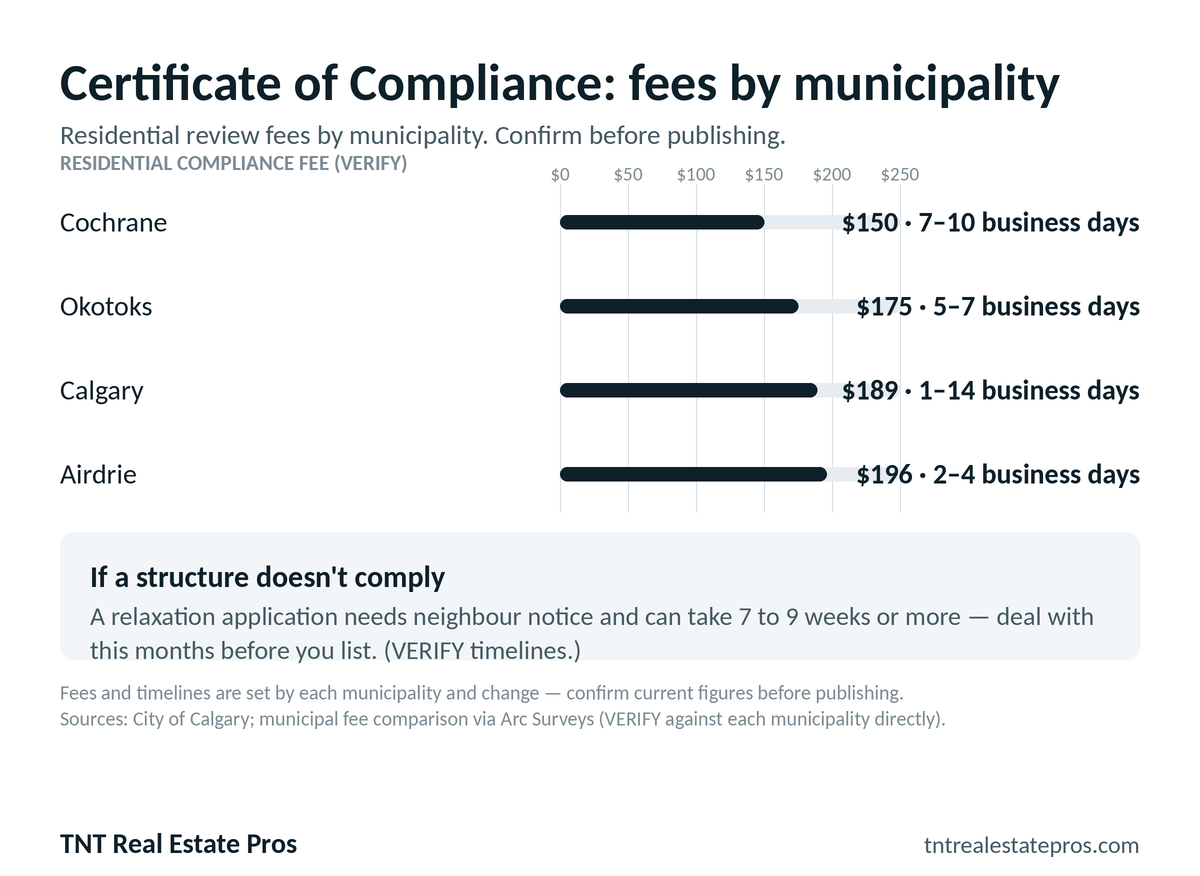
If you’re selling in one of the surrounding towns, confirm the current fee and timeline directly with that municipality — these change, and the figures above are a starting point, not a quote.
What if your RPR doesn’t comply?
This is the scenario that catches sellers off guard. If the municipality reviews your RPR and finds a structure too close to a property line — a deck, a fence, an addition, even a shed in the wrong spot — the Certificate of Compliance gets denied. From there, you generally have two paths:
- Fix it. Remove, move, or modify the structure, then resubmit — often at no extra review fee within a set window.
- Apply for a relaxation. This asks the municipality to approve the structure as-is. It requires neighbour notification, isn’t guaranteed, and takes real time — commonly 7 to 9 weeks in Calgary, longer in some surrounding municipalities.
Either path takes weeks, not days. That’s why this is one to deal with months before you list, not after you’ve already accepted an offer.
How we help
We ask about your RPR at our very first pre-listing conversation, not after you’ve got an accepted offer. If you don’t have one, if it’s old, or if you’ve added anything outside since it was done, we’ll point you to a surveyor, flag anything that looks like it could be a compliance issue, and build enough time into your listing plan to deal with it before it threatens a closing date. If something does come back non-compliant partway through a deal, we work with your lawyer on the fastest realistic path — a quick fix, a relaxation application, or an accepted alternative like title insurance — so it doesn’t cost you the sale. This is one piece of our full pre-listing process — see our guide for Calgary sellers for everything else we check before you list.
Want us to check what you’ll need before you list? Send us a message and we’ll walk through it together.
Frequently asked questions
Do I legally have to provide an RPR to sell my house in Alberta?
Not by law, but by contract. Alberta’s standard purchase contract expects sellers to provide one, and almost every buyer’s lender requires it (or an accepted alternative) before funding a mortgage.
What can I use instead of an RPR?
Title insurance is sometimes accepted, but it confirms title, not where your structures actually sit — it isn’t an automatic substitute, and whether it works depends on your buyer and their lender.
How long does getting a Real Property Report take?
Budget for the survey itself (timing varies by surveyor and season) plus the municipal compliance review — as little as a day or two in Calgary if everything is straightforward, or several weeks if a relaxation is needed. Start early.
What happens if my deck or fence doesn’t comply?
You can usually fix it and resubmit, or apply for a relaxation from the municipality, which requires neighbour notice and can take 7 to 9 weeks or more. We’ll help you figure out which route makes sense for your timeline.
Does my RPR expire?
Not on a set schedule, but it becomes outdated the moment you add or change anything visible outside — a new deck, fence, shed, or addition. At that point, a buyer’s lender will usually ask for an update.