


Your down payment is the headline number. It isn’t the whole story.
For most Calgary buyers, the minimum down payment is 5% of the purchase price, up to $500,000, then 10% on the portion above that. But your down payment isn’t the only cash you need on possession day — closing costs and a small cushion add to the total. On a home at Calgary’s overall benchmark price of about $569,800, that works out to roughly $32,000 in minimum down payment alone, before closing costs.
Here’s how to work out your own number, and why “the minimum” and “what you should actually save” aren’t always the same thing.
The minimum down payment rules (Canada-wide)
These rules come from CMHC and apply across Canada, including Calgary:
| Purchase price | Minimum down payment |
|---|---|
| $500,000 or less | 5% of the purchase price |
| Above $500,000, up to $1,500,000 | 5% on the first $500,000, plus 10% on the portion above $500,000 |
| $1,500,000 or more | Not eligible for mortgage default insurance — lenders generally require the conventional 20% down |
A quick example: on a $760,000 home, the minimum works out to about $51,000 (5% on the first $500,000, 10% on the remaining $260,000) rather than the conventional 20%, or $152,000, that an uninsured mortgage would require.
What that looks like on an actual Calgary home
Calgary’s benchmark prices vary a lot by home type. Here’s the minimum down payment at each, using CREB’s August 2026 benchmark prices:
| Home type | Benchmark price | Minimum down payment |
|---|---|---|
| Apartment condo | $295,400 | $14,770 |
| Row/townhouse | $415,200 | $20,760 |
| Calgary overall | $569,800 | $31,980 |
| Semi-detached | $690,500 | $44,050 |
| Detached | $744,300 | $49,430 |
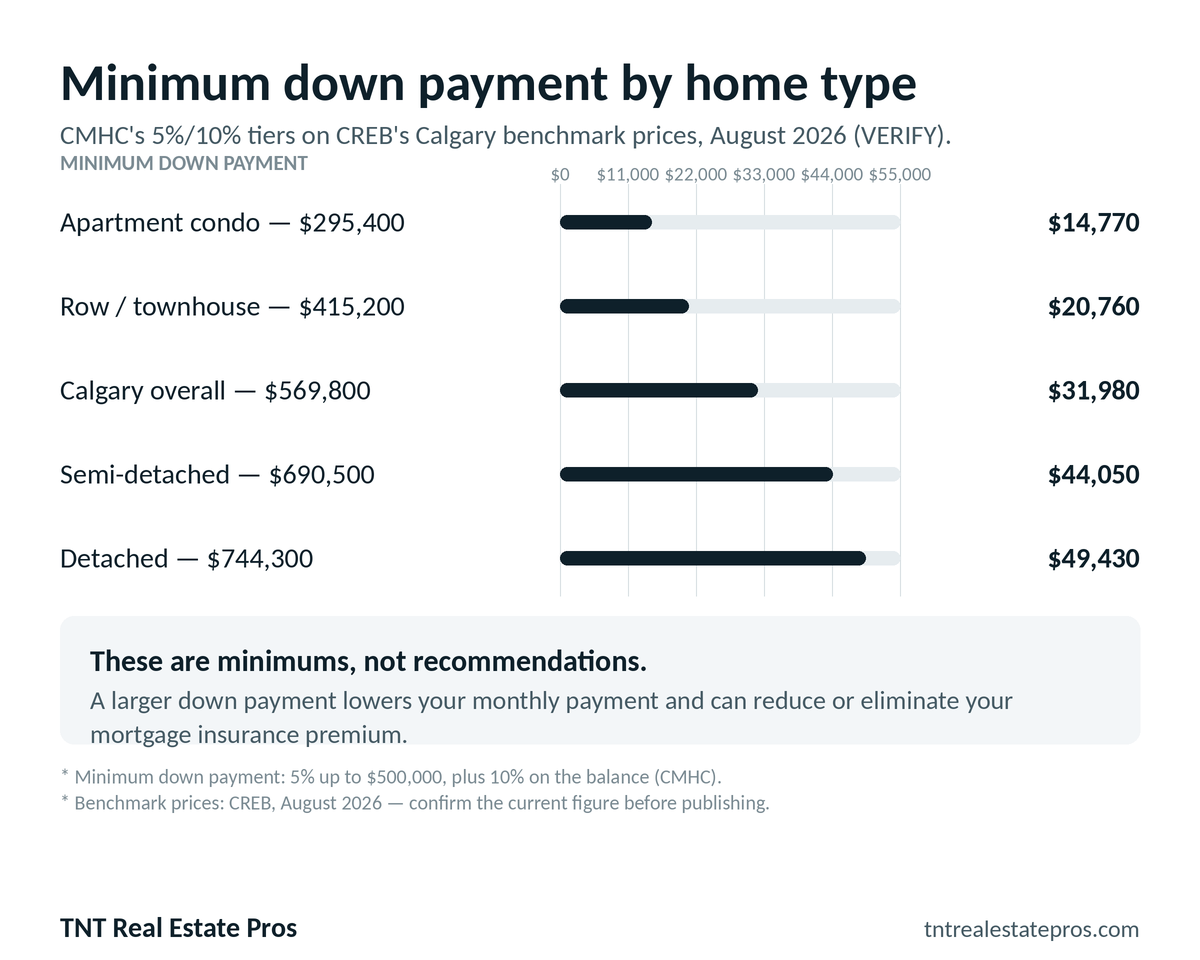
These are minimums, not recommendations. A larger down payment lowers your monthly payment, reduces or eliminates your mortgage insurance premium, and can make your offer more competitive in some situations — but it isn’t required to buy.
The trade-off with a smaller down payment
Putting down less than 20% means your mortgage needs default insurance, and that insurance isn’t free. CMHC’s premium is a one-time charge added to your mortgage amount, and it’s based on how much you’re borrowing relative to the home’s value:
| Your down payment | Loan-to-value | Insurance premium |
|---|---|---|
| 20% or more | 80% or less | No insurance needed |
| 15% to 19.99% | 80.01% to 85% | 2.80% of the loan |
| 10% to 14.99% | 85.01% to 90% | 3.10% of the loan |
| 5% to 9.99% | 90.01% to 95% | 4.00% of the loan |
On a $500,000 home with 5% down ($25,000), that’s a mortgage of $475,000 and an insurance premium of roughly $19,000, added to the loan rather than paid up front. It’s manageable, but it’s part of the real cost of a smaller down payment, and worth knowing before you decide how much to put down.
What about homes over $1.5 million?
Above $1,500,000, mortgage default insurance isn’t available at all. That means lenders generally require the conventional 20% down payment. If you’re buying at this price point, plan for that from the start rather than assuming the lower-percentage rules apply.
The other number: closing costs
Your down payment gets you the mortgage. It doesn’t cover the cash you need to actually close: legal fees, land title registration, inspection, insurance, and adjustments. We wrote a full breakdown in How Much Are Closing Costs When You Buy a Home in Calgary? — as a rule of thumb, plan for roughly 2% to 3% of the purchase price on top of your down payment.
A full example, at Calgary’s overall benchmark price:
| Purchase price | $569,800 |
| Minimum down payment (5%/10% tiers) | $31,980 |
| Closing costs (2% to 3%) | $11,400 to $17,100 |
| Total cash needed | roughly $43,000 to $49,000 |
That’s before any cushion. Which brings us to the number people forget.
Cash reserves: plan for a cushion
Down payment and closing costs get you to possession day. They don’t cover movers, the first grocery run, or the small thing that needs fixing once you’re actually living there. We tell our clients to keep a modest cushion set aside, separate from what you’ve budgeted for the purchase itself, so the first few weeks in a new home don’t feel like a scramble.
How to get pre-approved
Before you start touring homes, a pre-approval tells you what you can actually borrow, and locks in a rate for a set period while you shop. In general, a lender or mortgage broker will want to see your income documents, a look at your debts, and confirmation of where your down payment is coming from. We work with buyers before they’ve even picked a lender — happy to point you toward a few we trust, or work alongside the one you already have.
If you’re still building your down payment, ask your lender or mortgage broker about the First Home Savings Account and the Home Buyers’ Plan. Both can help first-time buyers put savings toward a home, and the details are worth a conversation with someone who knows your full picture.
How we help
We walk buyers through this exact math before they write an offer — not just the minimum, but what you’re comfortable with, and what it means for your monthly payment and your insurance premium. Then we stay with you through financing conditions, the appraisal, and everything else between offer and possession.
Want to know what your own number looks like? Send us a message and we’ll walk through it together.
Frequently asked questions
What’s the minimum down payment for a house in Calgary?
The same as anywhere in Canada: 5% of the purchase price up to $500,000, then 10% on the portion above that, up to $1,500,000. Above $1,500,000, lenders generally require 20% down.
Do I need 20% down to buy in Calgary?
No. Most buyers qualify with 5% to 10% down, depending on the price. Putting down less than 20% means paying a one-time mortgage insurance premium, added to your mortgage.
Is a bigger down payment always better?
Not always, but it has real advantages: a lower or eliminated insurance premium, a smaller monthly payment, and less interest paid over time. Whether it’s right for you depends on your other savings goals and reserves.
How much cash do I need beyond the down payment?
Budget 2% to 3% of the purchase price for closing costs, plus a personal cushion for moving costs and the first few weeks in your new home.
How do I know what I can actually afford?
A mortgage pre-approval is the real answer — it accounts for your income, debts, and down payment together. Our mortgage calculator is a good starting point, and we’re happy to connect you with a lender for the full picture.